

E10
The Energy Savings Scheme activity for an external blind, shutter or screen, named in both Home Energy Saver guidelines published in November 2026
0 of 3
Delivery partners (Creditex for discounts, Brighte and Plenti for loans) whose published product list included external shading on 14 November 2026
$150,000
The loan’s combined taxable household income cap from 10 November 2026, down from $210,000
0
Mentions of curtains, awnings or window film in the 1 July 2026 Energy Savings Scheme Rule or either guideline
What the guidelines say
Home Energy Saver is the NSW Government’s $557 million program of discounts of up to
$4,000 for lower-income households and zero-interest loans of up to $15,000 for owners and
landlords, run by the Department of Climate Change, Energy, the Environment and Water. Its
discount
guidelines (November 2026) list the upgrades a discount can pay for, and one line reads
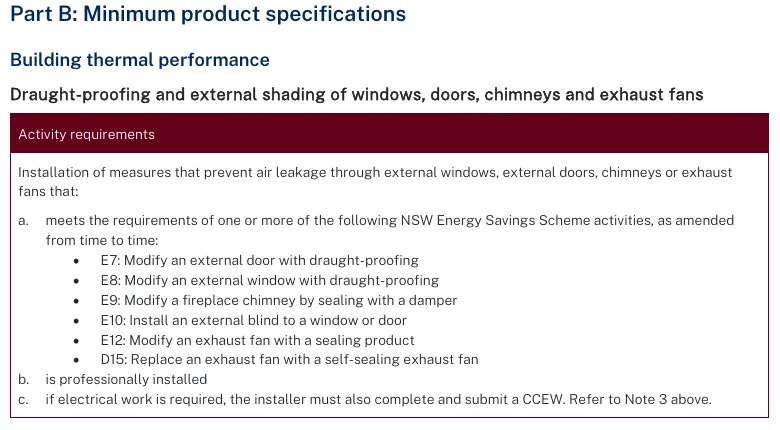
draught proofing and external shading of windows, doors, chimneys and exhaust fans
.
The loan
guidelines (version 2, November 2026) carry the same category in their approved product
list, and both documents define it the same way: the work must meet one of six Energy Savings
Scheme activities, among them
E10: Install an external blind to a window or door
A.
The loan guidelines are not consistent inside themselves. Their plain-English list of what a loan can pay for names “draught proofing windows and doors” and leaves shading out; the approved product list in the appendix, which the guidelines say decides what counts, includes it. The heading over the activity list also describes “measures that prevent air leakage”, which an external blind does not do.
What the department’s pages say
The department’s consumer page on
external shading
of windows and doors (last updated 15 December 2025) recommends shutters, awnings, solar
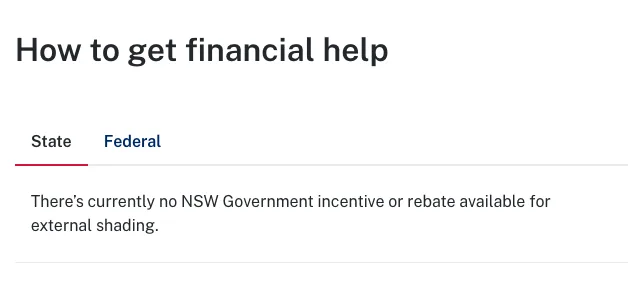
screens and exterior blinds, and then, under “How to get financial help”, says
There’s currently no NSW Government incentive or rebate available for external shading.
The program’s own web pages, updated 13 and 14 November, list draught-proofing and double
glazing among the eligible upgrades and do not mention shading.
Exhibit A · from the source
What the delivery partners offer
Households do not buy from the department. Discounts go through Creditex and loans through
Brighte or Plenti, and on 14 November none of their published lists included shading.
Creditex’s upgrade directory shows
eleven products, with draught sealing and double glazing the only window items. Brighte’s
loan page
lists double glazing, with draught proofing marked “Coming soon”. Plenti’s
loan page lists nine
upgrades under
The following eligible upgrades are currently available through Plenti:
with no glazing or shading among them. The discount guidelines allow for this:
The upgrades offered do not include every product available on the market.
| Document | External blinds, shutters, screens |
|---|---|
| Discount guidelines (November 2026) | Yes: listed upgrade, defined by activity E10 |
| Loan guidelines, version 2 (November 2026) | Yes in the approved product list; missing from the plain-English list |
| Program discount and loan pages (updated 13 and 14 November) | Not mentioned |
| Department external shading page (updated 15 December 2025) | No NSW Government incentive |
| Creditex, Brighte and Plenti product lists | Not listed by any of the three |
| Energy Savings Scheme Rule, 1 July 2026 | Yes: activity E10, in the Rule since at least March 2020 |
What E10 covers, and what it does not
E10 is not new. It sits in the
Energy
Savings Scheme Rule among the “low-cost activities” for home and small business
retrofits, and the version of 30 March 2020 carries the same wording and figures. Under the
Energy Savings Scheme, an accredited certificate provider earns certificates for the deemed
energy saving and passes some of their value on as a discount; the department’s
upgrades
page calls these “incentives”. The Rule says
The End-User Equipment must be an external shading device, such as a shutter, blind, vertical or horizontal building screen
with blades, battens or slats. The other conditions:
- it goes on the outside of a fully glazed external window or door, in a home or small business;
- not on a window facing south (between 135 and 225 degrees of true north);
- a motorised product must comply with AS/NZS 60335.2.97, the electrical safety standard for blind and shutter drives;
- at least a 5-year warranty, installed to the maker’s instructions;
- the purchaser pays at least $30 (excluding GST) for the job, unless it comes through a low-income or exempt program.
The Rule names no awning, curtain or window film, and it has nothing for a blind fitted inside the glass. The deemed saving is small: 0.05 MWh per square metre of covered glazing for a home in climate zones 2 to 4, and 0.02 to 0.04 in zones 5 to 8, with a 10-year lifetime. For comparison, the same Rule credits a double-glazed replacement window (U-value 3 or lower) in a home with 0.11 to 0.25 MWh of electricity per square metre, plus a gas saving.
The loan just narrowed
The second November change is to who can borrow. The loan guidelines say that from
10 November 2026
the household income threshold changed from $210,000 to $150,000
a year, with applications lodged before that date assessed against the old figure. The
department’s loans page carries the notice but still says $210,000 in two other places, and
its double glazing page, last updated 9 July, still quotes $210,000. Discounts are unchanged:
a concession card or a gross household income of up to $80,000, and renters can apply with the
landlord’s written permission.
If you want external shading under Home Energy Saver
- Ask the provider in writing whether it offers external shading under the program. The guidelines list it; the partners’ product lists do not.
- Check the window faces anywhere but south and that a motorised product meets AS/NZS 60335.2.97. Those are E10’s conditions.
- Internal blinds and curtains will not qualify under either scheme. In Victoria the energy upgrades program has no covering activity at all; see our report on its secondary glazing category.
- Borrowing? Use the $150,000 cap, not the $210,000 still printed on some department pages.
Our read
This section is opinion, built on the documents above.
A homeowner who reads the department’s shading page is told there is nothing for them. A homeowner who reads the program’s guidelines is told external blinds are an approved upgrade. Both are the same department, and the guidelines are the newer document. The page was also out of step before Home Energy Saver began: E10 has been an Energy Savings Scheme activity since at least 2020, and the department calls that scheme’s discounts incentives. External shading is the upgrade the department’s own page recommends for west-facing glass, and a landlord can fit it without replacing the window. The fix is a sentence on one page, plus a plain answer from the partners on whether they will offer it. The deemed saving per square metre is small next to double glazing, which may be why nobody is selling it under the scheme; that is our inference, not something any document says.
Sources
On method. Researched and written with AI systems under rules our small team sets and enforces, and drawn from the 10 primary sources below. 7 quotations are verified against archived copies of their sources by an automated word-for-word check. How The Window Standard works.
- NSW Department of Climate Change, Energy, the Environment and Water, Home Energy Saver discount guidelines (November 2026, read 14 November 2026): eligible upgrades, the program funding, Part A and Part B. Shown in Exhibit A (the loan guidelines carry the same list).
- NSW Department of Climate Change, Energy, the Environment and Water, Home Energy Saver loan guidelines, version 2 (November 2026, read 14 November 2026): the income threshold change, eligible upgrades, Parts A and B, page 19.
- NSW Department of Climate Change, Energy, the Environment and Water, External shading of windows and doors (updated 15 December 2025, read 14 November 2026). Shown in Exhibit A.
- NSW Department of Climate Change, Energy, the Environment and Water, Home Energy Saver loans (updated 13 November 2026) and Home Energy Saver discounts (updated 14 November 2026), read 14 November 2026.
- NSW Department of Climate Change, Energy, the Environment and Water, Double glazed windows (updated 9 July 2026) and Household energy saving upgrades, read 14 November 2026.
- Energy Savings Scheme Rule of 2009, effective from 1 July 2026 (NSW Government Gazette, 1 July 2026): clause 9.8, Table 1, Activity Definitions D1 and E10.
- Energy Savings Scheme Rule of 2009, version of 30 March 2020: Activity Definition E10, compared with the 2026 text.
- Creditex, Home Energy Saver upgrade directory (read in a browser 14 November 2026).
- Brighte, Home Energy Saver loan by Brighte (read 14 November 2026).
- Plenti, Home Energy Saver loans, households (read in a browser 14 November 2026).
How we did this. We downloaded both guidelines and the current and 2020 versions of the Energy Savings Scheme Rule, converted them to text and searched them in full; the word counts in the stats are whole-word searches of those three current documents. The department and partner pages were read on 14 November 2026, the JavaScript ones in a desktop browser, and saved. Our claim about the partners is about their published lists on that day; a partner may offer more on request. The savings figures are the Rule’s deemed values from Tables E10.1 and D1.2, not measured savings, and we have not converted them to certificates or dollars because certificate prices are set by the market. We have not asked the department or the partners about the gap. We have no commercial relationship with any business named here.
We will read the shading page and the three partners’ lists again, and add a dated note here when any of them changes.
Been quoted for external blinds or shutters under Home Energy Saver, or told they are not covered? Tell us and we will check it at the source and log the outcome here.